TechnoBusiness English
Gartner Unveils Top Strategic Predictions for 2027 and Beyond
Many industries are already using physical AI to improve safety, automate repetitive and hazardous work, and gain operational insights.


● Gartner’s top predictions span three categories: robots everywhere, cost to value and unknown unknowns.
● Technology and business leaders must assess how the following top predictions.
Jakarta, TechnoBusiness Insights ID ● Gartner, Inc., a business and technology insights company, has unveiled its top strategic predictions for 2027 and beyond. Gartner’s top predictions span three categories: robots everywhere, cost to value and unknown unknowns.
“Many of the systems we take for granted today, from public services to software, energy and workforce models, will be fundamentally transformed by AI over the next decade,” said Daryl Plummer, Distinguished VP Analyst and Gartner Fellow. “The most successful organisations will be those that balance innovation with responsibility, building the capabilities needed to manage both the opportunities and the unintended consequences of an AI-driven world.”
Technology and business leaders must assess how the following top predictions will influence their strategies and investments in 2027 and beyond.
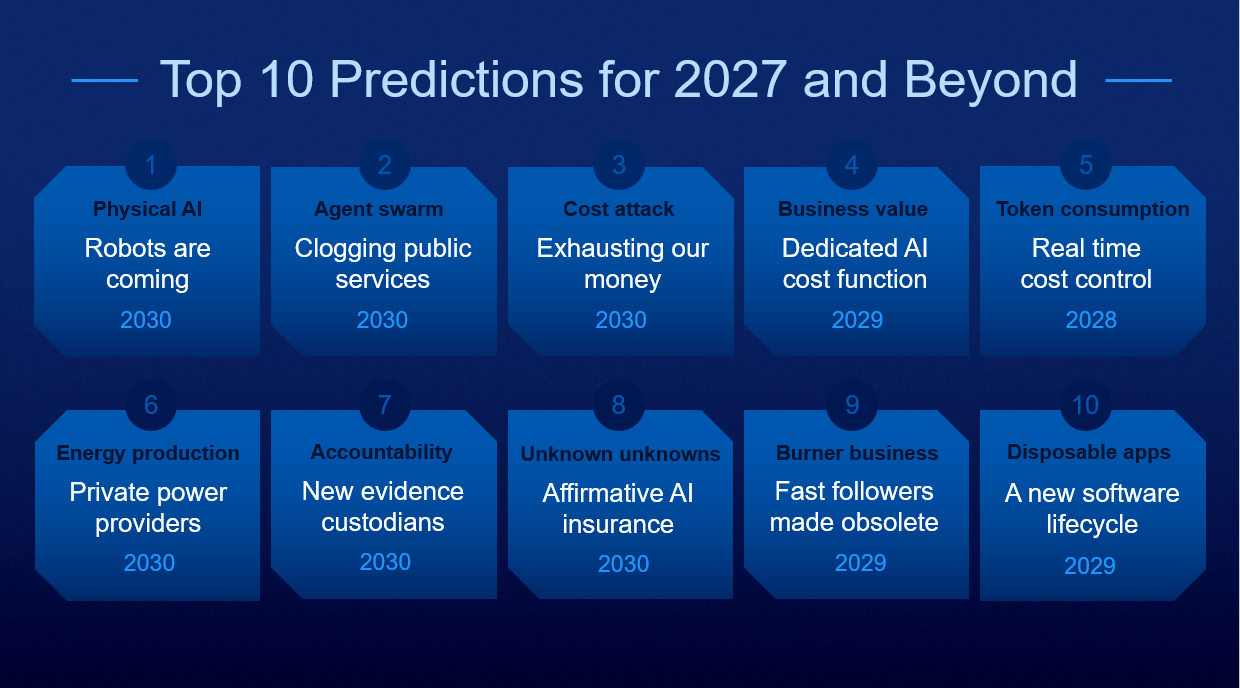
By the end of 2030, more than 10 billion autonomous agents created by people, companies and governments will clog public services.
Agentic AI will significantly increase demand for public services by enabling autonomous agents to identify opportunities, determine eligibility and submit requests on behalf of users with minimal human effort. This surge in applications, claims and transactions will put pressure on government systems and require stronger approaches to identity, trust and accountability. Gartner recommends governments prepare by modernising digital infrastructure, strengthening verification capabilities and planning for higher volumes of AI-mediated interactions.
By 2030, 80% of front-line workers employed by international companies will be assisted by physical AI systems.
Physical AI is extending AI into the physical world through technologies such as robots, drones, autonomous vehicles and other embodied systems that sense, interact with and influence their surroundings. Many industries are already using physical AI to improve safety, automate repetitive and hazardous work, and gain operational insights. Gartner recommends organisations take a strategic, safety-first approach by investing in scalable platforms, robust governance frameworks and the skills needed to deploy and manage physical AI systems effectively.
By 2030, 80% of organisations with public-facing AI will have experienced a cost exhaustion attack creating excessive AI cost.
The rise of public-facing AI is creating a new cybersecurity risk called cost exhaustion attacks, where malicious actors deliberately drive excessive AI usage to increase operational costs. As AI becomes more embedded in customer-facing applications, organisations will need to treat token consumption and AI usage patterns as both cost management and security concerns. Gartner recommends organisations make AI token costs a cybersecurity indicator, implement cost focused security controls, and extend monitoring capabilities across all AI technologies.
By 2029, 80% of new applications will be intentionally disposable – used for less than one year – revolutionising the software lifecycle.
AI is making application development so accessible that employees will increasingly create temporary applications to meet short-term business needs. Organisations face new governance, security, compliance and records management challenges, particularly when they influence decisions or access sensitive data. Gartner recommends organisations establish risk-based governance frameworks, monitor business-created applications through automated registries, and update records retention policies to address AI-generated applications and agents.
By 2030, US$10 trillion in enterprise-owned energy will make Global 2000 firms unexpected power providers – selling to grids and AI data centres, reshaping the utility industry.
Surging electricity demand from AI and data centres is driving enterprises to invest heavily in energy generation, storage and management assets, blurring the traditional line between energy consumers and power providers. As energy becomes a strategic, software-defined asset, organisations will need new capabilities to optimise production, storage and consumption. Gartner recommends enterprises invest in energy management platforms, integrate energy and operational data, and build governance and infrastructure to participate in emerging energy markets.
By 2030, insurers – not regulators – will drive AI governance, as strict underwriting standards for AI liability insurance will be required to reduce insurance costs.
Organisations are shifting from policy-based AI governance to operational governance that embeds controls directly into AI systems and workflows. As AI risks and liability concerns grow, insurers are expected to influence governance practices by encouraging stronger oversight, risk management and technical controls. Gartner recommends organisations implement AI governance technologies, test controls in real environments, and establish runtime oversight to support both innovation and accountability.
By 2029, 25% of Global 500 will continuously innovate componentised AI-powered offerings, creating a competitive moat that obsoletes fast follower strategies
As AI-native competitors introduce more customised, efficient and scalable offerings, established organisations face growing pressure to innovate or risk losing customers, talent and market share. Success depends not only on AI investments but also on strong data, governance and talent foundations that support scalable innovation. Gartner recommends organisations prioritise AI-powered customer innovation, strengthen data and analytics capabilities, and build adaptable workforces that can continuously create new sources of value.
By 2029, 60% of organisations deploying AI will establish a dedicated function responsible for mapping AI total cost to value or profit.
As organisations deploy more agentic AI, managing token consumption is becoming a business priority as costs rapidly escalate, making it increasingly difficult to link spending to business value. Organisations need greater visibility into AI consumption patterns and stronger governance to balance cost efficiency with value creation. Gartner recommends they link token usage directly to business value metrics, while implementing clear governance, quotas and monitoring controls to ensure AI investments deliver measurable returns.
By 2028, 60% of Global 500 companies will embed AI FinOps control at inference, shifting cost governance from reactive reporting to real-time optimisation.
AI spending is becoming harder to predict and control as organisations scale AI tools and agentic workflows, driving a shift from retrospective cost reporting to real-time AI FinOps governance. As AI becomes a larger operational expense, organisations will increasingly focus on measuring cost per task and token efficiency to maintain margins and maximise value. Gartner recommends organisations implement runtime cost controls, deploy inference-path telemetry and make cost governance a core requirement of AI platforms and applications.
By 2030, 80% of the Global 500 will contractually make their CIO (or CAIO) the “Evidence Custodian” for AI accountability.
As AI becomes embedded in critical business processes and decisions, organisations face increasing pressure to ensure accountability, transparency and oversight of AI actions. This is expanding the role of technology leaders in overseeing AI accountability and ensuring governance guardrails are applied consistently across the organisation. Gartner recommends organisations assess their digital evidence management capabilities and establish clear accountability for AI actions to support responsible AI governance.●
Text: TechnoBusiness Insights ID
Data: Gartners, September 2026
Photo: Pixabay